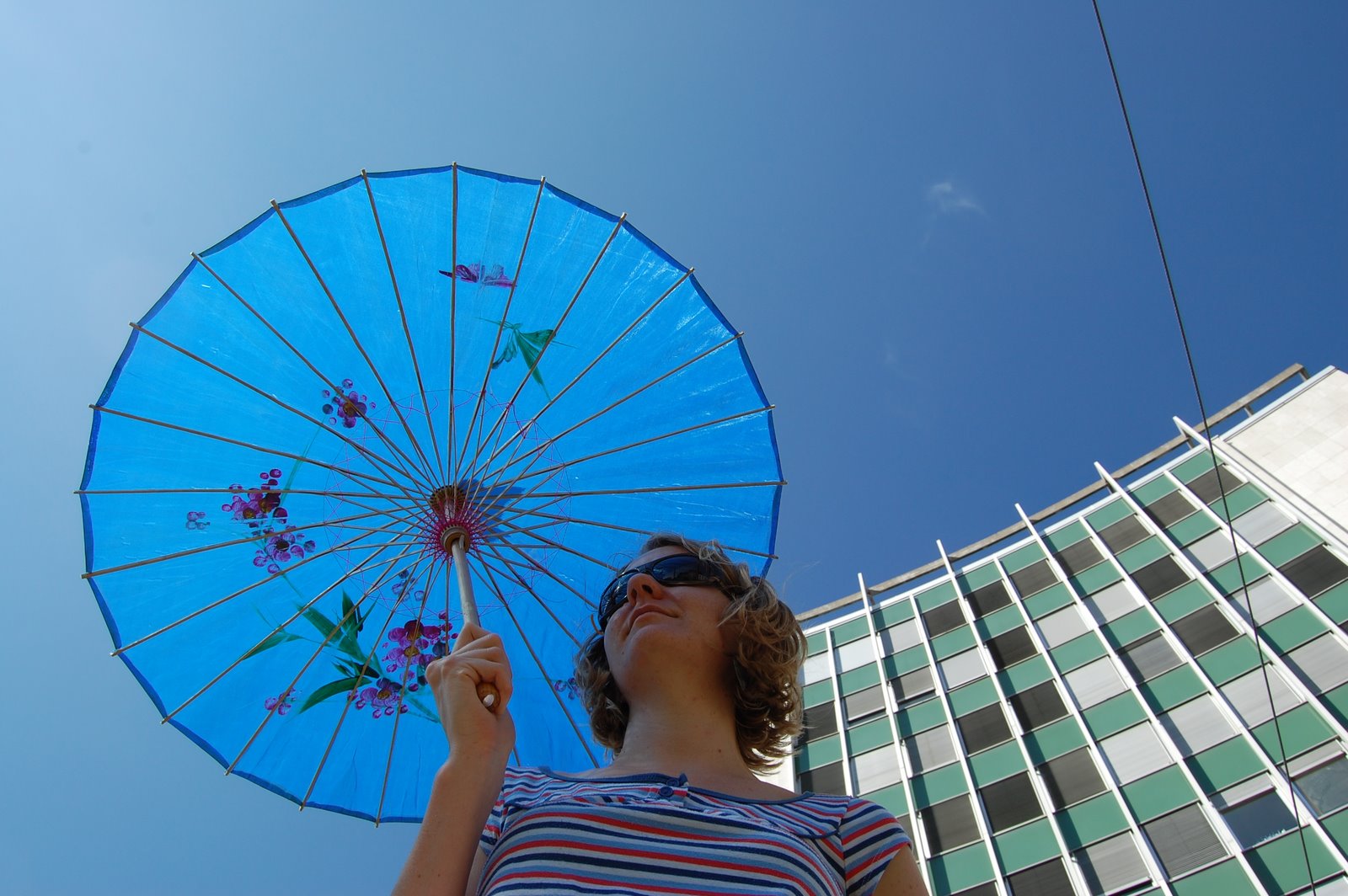
Much as it's always possible to carry on about the stereotypes and how Switzerland is so different and everything is so clean/organised/punctual etc here, I'm not really a big fan of these generalisations and I don't really find them to be true anyway (although it was kind of funny the day the two Swiss women in my french class both instantly shot their hands in the air when the teacher asked "so who thinks punctuality is important?" and everyone else was sort of ambivalent. Oh, apart from the Japanese woman, who said that it's better not to arrive at all than to be late because being late is just so rude).
Anyway - "Switzerland, don't believe the stereotypes", is my experience. But two things that always strike me as being odd here (and it's entirely possible that I'm just extrapolating this from"things Reto and his family normally do" to "things ALL Swiss people do ALL THE TIME") are:
1. You often don't get enough cutlery in restaurants. It doesn't always happen, and I'm sure in fancier places it never happens, but I often find that you sit at a table with each place set with a single knife and fork, you order an entree and a main meal, your entree arrives and you eat it, and then you see your (Swiss) husband putting his used cutlery back down on the table so that it won't be taken away with the (now empty) entree plate, saving it for re-use with the main course. Really? They can't give us more cutlery? I suppose that if you do have your cutlery taken away that the waiter will bring you some more for your main meal, and who knows, maybe that's actually what happens normally, but I'm so in the habit now of saving my first lot of cutlery that it hardly even seems odd any more. I was kind of surprised to have to explain it to my family when they were here visiting in Dec/Jan.
2. I suspect Swiss people have a different serviette-using policy to me. Firstly, no one here ever puts their serviette (napkin?) on their lap when eating, which I was always under the impression was the polite thing to do. The main point of difference though, becomes clear at the end of the meal when my serviette is back on the table and all scrunched into a ball after I've finished using it (not that that implies I'm using it excessively or eating with my fingers or dripping food all over the place or generally making a mess. I don't think I am). Then you look at the serviette of Reto and you can hardly tell he's touched his, although he has. He has wiped his mouth/fingers/whatever with his serviette and then folded it into a nice neat rectangle, usually with the dirty bits not showing although that could be a coincidence, and put it back on the table where it was before the meal started, and it doesn't look like it's been used at all. Seriously, you hardly even see a crease in it. Which can be problematic if you come from the "slacker" school of table clearing and generally only take away the dirty things (leaving clean stuff there for the next time).
Showing posts with label cruel generalisations. Show all posts
Showing posts with label cruel generalisations. Show all posts
Tuesday, 16 June 2009


Friday, 4 May 2007
Strewth
Reto and I were at the pub playing darts last weekend (I'd like to say I was winning, but I wasn't. There seems to be a time between half and one glass of beer when I am really, really bad at darts, and Reto is really quite good. Happily, though, due to the bizarre and annoying rules we play by, we switched scores at the last minute and then I won) and the bartender came and said hello to us. We made a bit of small talk, and he asked us where we were from (this is the english pub, so it was all in the lingua franca, aka english). I said I was from Australia and then we had a short and peculiar conversation about cricket (I don't think I or the bartender knew what we were talking about). Then the bartender asked Reto if he was Australian too. Reto said that he was from Switzerland. The bartender suggested that maybe he (Reto) has just been spending too much time with me.
Call me biased, but Reto doesn't sound Australian at all. When we first met I thought he sounded like he had a bit of an American accent when he spoke english (as did numerous other Australians who met him subsequently), but I would never have thought he was a native english speaker (he has too many weird ways of expressing himself in english to pass himself off as a non-ESL person). On several occasions over the last few years, though, people have assumed he is Australian after having a conversation with him. Probably because I am Australian, yes, but really. In my opinion, it only takes about 2 seconds of listening to him to realise that he has some bizarre European accent, and this is made all the more obvious when he tries to be an Australian. I tried to teach him to say "ya flamin' galah" the other day, with endearing and predictably bad results.
Call me biased, but Reto doesn't sound Australian at all. When we first met I thought he sounded like he had a bit of an American accent when he spoke english (as did numerous other Australians who met him subsequently), but I would never have thought he was a native english speaker (he has too many weird ways of expressing himself in english to pass himself off as a non-ESL person). On several occasions over the last few years, though, people have assumed he is Australian after having a conversation with him. Probably because I am Australian, yes, but really. In my opinion, it only takes about 2 seconds of listening to him to realise that he has some bizarre European accent, and this is made all the more obvious when he tries to be an Australian. I tried to teach him to say "ya flamin' galah" the other day, with endearing and predictably bad results.
Sunday, 22 April 2007
Cheers
In an effort to combine the admirable features of being a little bit more civilised and of drinking more, Reto and I have added the excellent feature of cocktail hour to our household. After a few practice runs on the previous weekend, we had our official inaugural drinking frenzy, I mean civilised drink on the balcony, last Friday evening. We had excellent heavy glasses, we had gin, we had tonic, as had slices of lemon, we had ice cubes (no small thing in this country, where as it turns out it’s hard to buy an ice cube tray. After a long and fruitless search of Aarau for this very thing though, I got home and realised we already had one, in the freezer, full of ice). Not only this, we had the pleasantly setting afternoon sun, we had the strains of the accordion as played by the woman over the road who seems to like to sit in her garden and practice (which might seem as though it should be horrible, but I really enjoy it. Think more Amelie soundtrack than lunatics and Germans), and we had blini with smoked salmon, crème fraiche and dill.
It was all ridiculously upmarket and fancy until we got a bit carried away, finished half the bottle of gin and ended up sprawled all over the place like a couple of drunks. Aah, the fun of being a sporadic drinker.
It was all ridiculously upmarket and fancy until we got a bit carried away, finished half the bottle of gin and ended up sprawled all over the place like a couple of drunks. Aah, the fun of being a sporadic drinker.
Friday, 23 March 2007
Not A Very Interesting Tale
Owing to overwhelming requests from my adoring public, I am bringing to you a non-comprehensive, and largely non-offensive, account of Being A Spectator At A Curling Match.
You turn up. As so often happens in Switzerland, there are eating opportunities aplenty. The curling hall place is basically a small ice rink thing and a restaurant that sells allegedly the most delicious apple pie ever, but I am not in a position to either confirm or deny that. Their coffee is perfectly acceptable, though, and there is also the endless entertainment of seeing what picture you will get on the lid thing of your coffee cream thing (I seem to be haunted endlessly by camels lately. I realise that this probably doesn't make any sense. Maybe I'll clear it all up on some other slow news day).
I was expecting that the ice rink would be a normal one, ie. big and oval with small children falling over on the peripheries. The rink here is small and rectangular, all marked up with curling lines and things, and is OBVIOUSLY NOT A RINK ON WHICH ANY SORT OF NON-CURLING ACTIVITIES WILL TAKE PLACE. Not to perpetuate any unfair and outdated stereotypes, but you should remember that this is Switzerland after all, home of not having fun and then tidying up after yourself.
Curling, as I have said before, is basically lawn bowls in warmer clothes. Not that I really know how to play lawn bowls either, nor do I know what the rules are (in spite of the fact that I chose it for school sport on more than one occasion. When I wasn't busy playing golf, the other slacker's choice of low-impact torment at school. Sadly I didn't go to one of those schools where "going to the beach" or "dancing in a nightclub" was considered an acceptable sport substitute, and I'm sure that that was not only because the closest beach to my school was hundreds of kilometres away, nor that there was only one nightclub in town and if you went there you were in danger of running into your maths teacher who was out drinking more than can be appropriate for a supposed role model type, blahblahblah). Anyway. Curling is the same as lawn bowls if lawn bowls is like this:
There are 4 people on a team. You try to bowl your bowls to the target area, which is marked on the grass. The people on the other team try to knock your bowls out of the way, or they try to get their bowls closer to the middle of the target (aka the kitty) than yours are. You get a point for each of your bowls that are both within the designated target area and closer than the closest of your opponents bowls to the kitty. The captain of the team stands at the target end and tells you where to aim for by pointing in a strangely effete manner with a rake (which seems a whole weird science of its own, what with the curly nature of the path of the bowl and the fact that blocking the path of your opponents is often a better strategy than just trying to get your bowls near the kitty), and the other two team members either enthusiastically rake the grass in front of your bowl, or they don't, depending on whether the bowl needs help to get to where it is trying to go or not. And then, when everyone has had a go and points have been won (or not), you start again from the other end. And then again and again, up to 10 times until you have (finally) finished a match.
Obviously to fully understand the above as curling the following substitutions must be made: ice for grass, rocks for bowls, button for kitty, house for target area, skip for captain, broom for rake, and sweep the ice for rake the grass.
So. You sit there with your coffee and your book and you watch people bowling bowls or throwing rocks (or whatever it's called) and sweeping and strategising, and one of the first things you notice is that the only reason there are 4 people on the team is so that there are enough people to do the sweeping. Basically, whatever the first two people do with their rocks is pretty irrelevant, because they have long been knocked out of the way by the end of the match. Even the third player is a bit peripheral to the outcome, frankly.
The next thing you notice is that curling is a sport that all ages can embrace. There is lots of bending of the knees involved, so possibly it wouldn't be the sport of choice for my mother (who has one gammy knee these days, as well as a fake hip) but it seems that anyone with functional knees and a reasonable sense of balance can embrace it. The chance of being injured seems minimal, too, although Reto did have a big horrible blistery thing on his thumb after playing last weekend (very similar to a wound I once got while tenpin bowling, actually). Anyway, in a heartwarming display of community or the universal appeal of slow, dull sports, the ice was dotted with oldies and youngies and the odd person in between. Not that I am implying that my boyfriend is particularly old or young or odd.
And then ... well, I'm not sure there is a whole lot more to it, actually. They play thousands of ends and then the winning team buys the losing team some drinks and it's all very jovial and friendly. Then you go home and your allegedly sporty boyfriend uses his pathetic thumb wound as an excuse not to do the washing up.
Incidentally, on the weekend, Reto's team was trounced in their first match, and then they did the trouncing in the second one. I don't remember the scores. I was too busy reading.
You turn up. As so often happens in Switzerland, there are eating opportunities aplenty. The curling hall place is basically a small ice rink thing and a restaurant that sells allegedly the most delicious apple pie ever, but I am not in a position to either confirm or deny that. Their coffee is perfectly acceptable, though, and there is also the endless entertainment of seeing what picture you will get on the lid thing of your coffee cream thing (I seem to be haunted endlessly by camels lately. I realise that this probably doesn't make any sense. Maybe I'll clear it all up on some other slow news day).
I was expecting that the ice rink would be a normal one, ie. big and oval with small children falling over on the peripheries. The rink here is small and rectangular, all marked up with curling lines and things, and is OBVIOUSLY NOT A RINK ON WHICH ANY SORT OF NON-CURLING ACTIVITIES WILL TAKE PLACE. Not to perpetuate any unfair and outdated stereotypes, but you should remember that this is Switzerland after all, home of not having fun and then tidying up after yourself.
Curling, as I have said before, is basically lawn bowls in warmer clothes. Not that I really know how to play lawn bowls either, nor do I know what the rules are (in spite of the fact that I chose it for school sport on more than one occasion. When I wasn't busy playing golf, the other slacker's choice of low-impact torment at school. Sadly I didn't go to one of those schools where "going to the beach" or "dancing in a nightclub" was considered an acceptable sport substitute, and I'm sure that that was not only because the closest beach to my school was hundreds of kilometres away, nor that there was only one nightclub in town and if you went there you were in danger of running into your maths teacher who was out drinking more than can be appropriate for a supposed role model type, blahblahblah). Anyway. Curling is the same as lawn bowls if lawn bowls is like this:
There are 4 people on a team. You try to bowl your bowls to the target area, which is marked on the grass. The people on the other team try to knock your bowls out of the way, or they try to get their bowls closer to the middle of the target (aka the kitty) than yours are. You get a point for each of your bowls that are both within the designated target area and closer than the closest of your opponents bowls to the kitty. The captain of the team stands at the target end and tells you where to aim for by pointing in a strangely effete manner with a rake (which seems a whole weird science of its own, what with the curly nature of the path of the bowl and the fact that blocking the path of your opponents is often a better strategy than just trying to get your bowls near the kitty), and the other two team members either enthusiastically rake the grass in front of your bowl, or they don't, depending on whether the bowl needs help to get to where it is trying to go or not. And then, when everyone has had a go and points have been won (or not), you start again from the other end. And then again and again, up to 10 times until you have (finally) finished a match.
Obviously to fully understand the above as curling the following substitutions must be made: ice for grass, rocks for bowls, button for kitty, house for target area, skip for captain, broom for rake, and sweep the ice for rake the grass.
So. You sit there with your coffee and your book and you watch people bowling bowls or throwing rocks (or whatever it's called) and sweeping and strategising, and one of the first things you notice is that the only reason there are 4 people on the team is so that there are enough people to do the sweeping. Basically, whatever the first two people do with their rocks is pretty irrelevant, because they have long been knocked out of the way by the end of the match. Even the third player is a bit peripheral to the outcome, frankly.
The next thing you notice is that curling is a sport that all ages can embrace. There is lots of bending of the knees involved, so possibly it wouldn't be the sport of choice for my mother (who has one gammy knee these days, as well as a fake hip) but it seems that anyone with functional knees and a reasonable sense of balance can embrace it. The chance of being injured seems minimal, too, although Reto did have a big horrible blistery thing on his thumb after playing last weekend (very similar to a wound I once got while tenpin bowling, actually). Anyway, in a heartwarming display of community or the universal appeal of slow, dull sports, the ice was dotted with oldies and youngies and the odd person in between. Not that I am implying that my boyfriend is particularly old or young or odd.
And then ... well, I'm not sure there is a whole lot more to it, actually. They play thousands of ends and then the winning team buys the losing team some drinks and it's all very jovial and friendly. Then you go home and your allegedly sporty boyfriend uses his pathetic thumb wound as an excuse not to do the washing up.
Incidentally, on the weekend, Reto's team was trounced in their first match, and then they did the trouncing in the second one. I don't remember the scores. I was too busy reading.
Thursday, 1 March 2007
Two Hours Of My Life I Will Never Get Back
Being the dedicated girlfriend that I have apparently become, I went to watch Reto compete in a curling match last night. I don't know what I was thinking.
Both playing and watching, I hate almost all forms of sport, and to the best of my knowledge I always have. I used to like to try to make myself feel more open-minded by trying to convince myself that I only hated team sports or ball sports or sports that had to be played on grass. Then I thought that perhaps I might not hate sports that are vaguely ludicrous and that can be played by anyone regardless of physical incapacity or drunkenness (and admittedly there are a few of these that I have some time for. Darts, for example, although it starts to wear thin unless you are in a pub with a beer in your hand, threatening the safety of people who sit too close to the board. Luge always seemed kind of nice too, involving, as it does, people doing a very, very small amount of running and then having a good lie-down).
Curling always seemed like it might be on my "tentatively approved" list as well, what with all the standing around punctuated by entertainingly frenzied bouts of sweeping, and the looks of grim determination usually only seen on the faces of ladies at the local bowling club. I now realise, however, that I was wrong.
Curling is the single most uninteresting sport on the planet*. I'd bore you with the details except I think I was too comatose from lack of anything much happening to remember any. Even if you the game holds some amount of novelty (because you have never actually seen it played before. And I am still willing to admit that the sweeping aspect is vaguely comical), even if you are going to support your beloved boyfriend, even if you have coffee and a book to help you through, it's still advisable to stay at home and watch McLeod's Daughters in italian and tear your own fingernails out than try to sit through a match.
I love you, Reto, but apparently not that much.
* Actually, this might just be hyperbole on my part. I'm sure it's no more uninteresting than any other sport (with the possible exception of luge or darts)
Both playing and watching, I hate almost all forms of sport, and to the best of my knowledge I always have. I used to like to try to make myself feel more open-minded by trying to convince myself that I only hated team sports or ball sports or sports that had to be played on grass. Then I thought that perhaps I might not hate sports that are vaguely ludicrous and that can be played by anyone regardless of physical incapacity or drunkenness (and admittedly there are a few of these that I have some time for. Darts, for example, although it starts to wear thin unless you are in a pub with a beer in your hand, threatening the safety of people who sit too close to the board. Luge always seemed kind of nice too, involving, as it does, people doing a very, very small amount of running and then having a good lie-down).
Curling always seemed like it might be on my "tentatively approved" list as well, what with all the standing around punctuated by entertainingly frenzied bouts of sweeping, and the looks of grim determination usually only seen on the faces of ladies at the local bowling club. I now realise, however, that I was wrong.
Curling is the single most uninteresting sport on the planet*. I'd bore you with the details except I think I was too comatose from lack of anything much happening to remember any. Even if you the game holds some amount of novelty (because you have never actually seen it played before. And I am still willing to admit that the sweeping aspect is vaguely comical), even if you are going to support your beloved boyfriend, even if you have coffee and a book to help you through, it's still advisable to stay at home and watch McLeod's Daughters in italian and tear your own fingernails out than try to sit through a match.
I love you, Reto, but apparently not that much.
* Actually, this might just be hyperbole on my part. I'm sure it's no more uninteresting than any other sport (with the possible exception of luge or darts)
Wednesday, 14 February 2007
Can Anyone Give Me Wood?
Switzerland is apparently the home of board games, card games, any sort of distraction that is sociable but that means you don't have to make conversation. Reto's family is obsessed (well, possibly that is a bit harsh but they are definitely enthusiastic) with playing a boardgame called Die Siedler von Catan which is all about colonising a new country or something similar. The game involves building bridges and houses (or something) by trading cards representing things (such as brick and grains and wood and sheep) with the other players.
The other day I was listening to Reto and assorted others playing this game (I was taking part in the less sociable but more entertaining pasttime of reading my book because I am the sort of spoilsport party-pooper who can't stand board games or card games or any type of organised activity at all), and it seemed to me that every minute or so, someone would earnestly say "Does anyone have wood?", "Does anyone want to give me wood?", "I've got wood but I've got no stones". This was a largely ESL* crowd, and possibly they might not appreciate the humour in these statements, but I was quietly giggling to myself until I could take it no more. "What the hell is wrong with you people? Don't you realise how hilarious this is?" I yelled at them, and they stared at me blankly, before ignoring me and carrying on.
"I need some weed" said the next player, pronouncing "wheat" slightly strangely.
These foreigners are crazy.
* English as a Second Language
The other day I was listening to Reto and assorted others playing this game (I was taking part in the less sociable but more entertaining pasttime of reading my book because I am the sort of spoilsport party-pooper who can't stand board games or card games or any type of organised activity at all), and it seemed to me that every minute or so, someone would earnestly say "Does anyone have wood?", "Does anyone want to give me wood?", "I've got wood but I've got no stones". This was a largely ESL* crowd, and possibly they might not appreciate the humour in these statements, but I was quietly giggling to myself until I could take it no more. "What the hell is wrong with you people? Don't you realise how hilarious this is?" I yelled at them, and they stared at me blankly, before ignoring me and carrying on.
"I need some weed" said the next player, pronouncing "wheat" slightly strangely.
These foreigners are crazy.
* English as a Second Language
Friday, 9 February 2007
What The Swiss Believe In (part 2)
The more entertaining and simple statues of Aarau having been dealt with previously, we now move on to Statues 201. What can you assume about the nature of our Switzy friends from this:
 I think the following should be considered:
 I think the following should be considered:
- A fondness for weaponry and killing (as previously discussed), hence the sword;
- A fondness for leg-revealing dress-wearing (as previously discussed), hence the dress and legs;
- A fondness for precision, hence the scales. Who other than a nation of pedants would garner a reputation for their watchmaking abilities?;
- An unwillingness or inability to see reality, hence the blindfold and peep-toe sandals. With their neutrality and their choice not to join the EU, it's as though the Swiss choose not to acknowledge the world around them. Similarly, what sort of insane weather-denier would wear open-toed shoes in the depths of a Swiss winter (I realise that I shouldn't be casting such aspersions given the poor quality and inappropriateness of my shoe choices, but no one can actually see my toes so I retain the moral high ground)?; and
- A flair for efficiency. They are obviously packing as many stereotypes into the one statue as they possibly can.
The only other statue we will consider today is this one, and I think that it really speaks for itself:
 It's obviously a declaration of proud sense of isolation that all Swiss people feel in their hearts. That they stand alone, quiet and dignfied, and they stoically bear (no pun intended) all that is thrust upon them. They don't need to hide behind details, and they have within themselves all that they need to defend their people and their nation. They might have a reputation for being a bit impenetrable and cranky, and maybe they would go so far as to climb a tree in order to swat you out of it and eat you to death, but then again maybe they are just furry and misunderstood.
Either that or Switzies just like bears, I guess.
Tuesday, 6 February 2007
When Art And Life Overlap (part one)
Shortly before I left Australia I was given a copy of The Swiss Family Robinson by a very dear friend. Now that I have read it (actually, I started it on Saturday night and I haven't finished it yet, thanks to my relentlessly annoying boyfriend and his apparent need for constant attention) I have some extremely interesting and relevant points to make about the unchanging nature of the Swiss psyche. Please bear in mind that the book was written in 1812.
1. The Swiss are a bunch of misogynistic bastards. This should come as no surprise to anyone who realises that WOMEN WEREN'T EVEN ALLOWED TO VOTE IN THIS COUNTRY UNTIL 1971. In 1812, our friend Frau Robinson, aka "the wife" or "the mother" (as in "The mother found the scene all too horrible, and hastened into the cave, trembling and distressed") is one-dimensional to say the least. Her only emotions seem to be negative ones. She is usually fearful, anxious, horrified, aghast. Rarely does she get the chance to speak in whole sentences, and when she does it is usually only to panic needlessly, or to say something that, as her husband kindly points out, is incorrect (after suggesting that her sons should not eat the snake they just killed, her husband corrects her. "Excuse me, my dear wife", he begins, before elaborating proudly on all the reasons why she was wrong to hamper her sons so). On the occasions when she manages to escape her husband's withering embrace and actually do something herself, she is patronised almost into a coma ("You have done far more than I could have expected, wife", "Did you not find the work too hard?"). She can never be left at their house alone without at least an 8 year old boy or a dog there to protect her. She cannot be trusted with a gun, even though everyone else, even the 8 year old, is armed to the teeth. Not to ruin the plot for you, towards the end of the book another person turns up, an English woman in her 20s. She has been self-sufficient after being shipwrecked some 3 years previously (and has achieved much, "the quarter of which would completely have appalled the generality of her sex", apparently), but as soon as the Swiss Family Robinson find her they can hardly wait to get her into a dress, leave her to wait with "the mother" whenever there is work to be done, and to insist that even inspecting all aspects of the house where TSFR live would "tire the poor girl out".
Compare this to Switzerland today, where, as mentioned, women have only recently begun to vote, they are vastly underrepresented in full time work, in parliament, in upper management type employment, where they earn significantly less than men in equivalent roles, where childcare places are scarce to the point of non-existence and where school hours are so variable that women have often little choice but to entirely leave the workforce when they have children. At least the wife Robinson was only the last of 6, not the last of 7 million.
2. The Swiss like weapons. In TSFR (as it shall henceforth be known) the menfolk are obsessed with running around the island and shooting everything in sight (obviously Mrs Robinson is at home cooking and cleaning and sewing new clothes for everyone, as befits a woman. Hopefully she finds time to have an affair with an impressionable young graduate, too, in between peeling kangaroos and being thoroughly patronised for managing to collect a few acorns). Every time the menfolk see a flock of flamingos wading in a marsh or a brace of penguins frolicking on the beach, little time is spared for wonderment at these scenes of natural beauty before someone whips out a gun, shoots everything they possibly can and then they all comment on how well they will eat tonight. Even better is the opportunity to slaughter some sort of animal that has never been either seen or killed before ("Franz was overjoyed to find that he had shot a 'new creature' "). Rarely does anyone walk more than a few metres without first arming themselves with at least one gun, usually more, as well as a bow and arrows and a lasso. Sticks are often flailed against the treacherous creatures they come across (such as the wildly dangerous angora bunnies), and they have no hesitation in throwing rocks at monkies, setting their dogs loose on porcupines, or harpooning tortoises.
Note the current fondness of the Swiss for being in the army and bearing weapons. Note their obligatory target practice twice a year (or however often it is). Note their souvenir of note, the Swiss Army Knife. Note my boyfriend's bayonet (no innuendo, please).
3. The Swiss like to eat dead things. See point number 2 with regard to killing everything they see. No animal is safe from being eaten by the Swiss Family Robinson.
I don't know about actual statistics or so-called evidence that the Switzies are a bunch of carnivores, but every time I go anywhere here I feel like someone is making me eat another rabbit or cow or mystery-meat product. You have no idea how happy the sight of a chick pea makes me these days.
1. The Swiss are a bunch of misogynistic bastards. This should come as no surprise to anyone who realises that WOMEN WEREN'T EVEN ALLOWED TO VOTE IN THIS COUNTRY UNTIL 1971. In 1812, our friend Frau Robinson, aka "the wife" or "the mother" (as in "The mother found the scene all too horrible, and hastened into the cave, trembling and distressed") is one-dimensional to say the least. Her only emotions seem to be negative ones. She is usually fearful, anxious, horrified, aghast. Rarely does she get the chance to speak in whole sentences, and when she does it is usually only to panic needlessly, or to say something that, as her husband kindly points out, is incorrect (after suggesting that her sons should not eat the snake they just killed, her husband corrects her. "Excuse me, my dear wife", he begins, before elaborating proudly on all the reasons why she was wrong to hamper her sons so). On the occasions when she manages to escape her husband's withering embrace and actually do something herself, she is patronised almost into a coma ("You have done far more than I could have expected, wife", "Did you not find the work too hard?"). She can never be left at their house alone without at least an 8 year old boy or a dog there to protect her. She cannot be trusted with a gun, even though everyone else, even the 8 year old, is armed to the teeth. Not to ruin the plot for you, towards the end of the book another person turns up, an English woman in her 20s. She has been self-sufficient after being shipwrecked some 3 years previously (and has achieved much, "the quarter of which would completely have appalled the generality of her sex", apparently), but as soon as the Swiss Family Robinson find her they can hardly wait to get her into a dress, leave her to wait with "the mother" whenever there is work to be done, and to insist that even inspecting all aspects of the house where TSFR live would "tire the poor girl out".
Compare this to Switzerland today, where, as mentioned, women have only recently begun to vote, they are vastly underrepresented in full time work, in parliament, in upper management type employment, where they earn significantly less than men in equivalent roles, where childcare places are scarce to the point of non-existence and where school hours are so variable that women have often little choice but to entirely leave the workforce when they have children. At least the wife Robinson was only the last of 6, not the last of 7 million.
2. The Swiss like weapons. In TSFR (as it shall henceforth be known) the menfolk are obsessed with running around the island and shooting everything in sight (obviously Mrs Robinson is at home cooking and cleaning and sewing new clothes for everyone, as befits a woman. Hopefully she finds time to have an affair with an impressionable young graduate, too, in between peeling kangaroos and being thoroughly patronised for managing to collect a few acorns). Every time the menfolk see a flock of flamingos wading in a marsh or a brace of penguins frolicking on the beach, little time is spared for wonderment at these scenes of natural beauty before someone whips out a gun, shoots everything they possibly can and then they all comment on how well they will eat tonight. Even better is the opportunity to slaughter some sort of animal that has never been either seen or killed before ("Franz was overjoyed to find that he had shot a 'new creature' "). Rarely does anyone walk more than a few metres without first arming themselves with at least one gun, usually more, as well as a bow and arrows and a lasso. Sticks are often flailed against the treacherous creatures they come across (such as the wildly dangerous angora bunnies), and they have no hesitation in throwing rocks at monkies, setting their dogs loose on porcupines, or harpooning tortoises.
Note the current fondness of the Swiss for being in the army and bearing weapons. Note their obligatory target practice twice a year (or however often it is). Note their souvenir of note, the Swiss Army Knife. Note my boyfriend's bayonet (no innuendo, please).
3. The Swiss like to eat dead things. See point number 2 with regard to killing everything they see. No animal is safe from being eaten by the Swiss Family Robinson.
I don't know about actual statistics or so-called evidence that the Switzies are a bunch of carnivores, but every time I go anywhere here I feel like someone is making me eat another rabbit or cow or mystery-meat product. You have no idea how happy the sight of a chick pea makes me these days.
Wednesday, 31 January 2007
What The Swiss Believe In (part 1)
It is a well known fact that the Swiss love their flag. Ditto that they are heavily involved in the military. It is less widely known that the men apparently like to wear very short dresses and dance with each other, but all these fascinating aspects of Swiss culture come together and are celebrated at the Aarau train station:

 And once you are appropriately warmed up, why not try a spot of tai chi?:
 I'm sure all these statues (and all the other ones that you are yet to see) commemorate worthy things (like soldiers and dead people and actual things that the Swiss do hold dear), but really. If you are going to make art, and you want it to have a serious meaning, why not try to make it a little bit less funny looking?
Similarly, the value of stretching is revered by the Swiss. Specifically, stretching while naked and elevated and in public. In some countries you might be arrested for such behaviour, but here you are more likely to be immortalised in bronze:
And once you are appropriately warmed up, why not try a spot of tai chi?:I'm sure all these statues (and all the other ones that you are yet to see) commemorate worthy things (like soldiers and dead people and actual things that the Swiss do hold dear), but really. If you are going to make art, and you want it to have a serious meaning, why not try to make it a little bit less funny looking?
Subscribe to:
Posts (Atom)